Water and sewer utilities · municipalities · network operators
Manholes, pumping stations and collectors that report problems themselves
Pumping stations with no telemetry, manholes scattered across a municipality, retention tanks, collectors and overflows: an LTE sensor hung under the cover sends the level, and in the new version also the flow, to one panel and alerts the dispatcher before sewage reaches the surface.
The problem
What happens when nobody is looking
Sites with no power and no telemetry
Most manholes have neither electricity nor connectivity. The LTE transmitter runs on a battery for up to 2 years and has its own SIM card: installation means hanging it under the cover, with no construction work.
The dispatcher hears about it from residents
An alarm threshold on level and on how long it holds; push and e-mail notifications to the people you choose, with roles: administrator, service, viewer.
Level is not enough when you need a balance
The LTE level and flow sensor measures in a collector or on an overflow not only the sewage head but also the flow: you can see infiltration, overloaded sections and storm-overflow discharges without building a measuring chamber.
Places with patchy coverage
Logger mode: the sensor collects readings locally and sends them in a batch when it finds the network. The history stays continuous even if the connectivity does not.
Installation
It hangs under the lid. Nothing touches the liquid.
The transmitter hangs under the manhole cover on a stainless-steel bracket; it has no contact with the sewage, so it does not foul and needs no cleaning. IP67 housing, operation from −20 °C. If a cast-iron cover dampens the signal, the antenna goes out on a short extension; in practice this is rarely needed. Battery change roughly every 2 years, with no special tools.
Which variant
LTE level sensor: manholes and pumping stations
No receivers and no routers on site. Each sensor has a Premium LTE Flex plan with a SIM card; all sites in one organisation panel.
Aquilo LTE Liquid Level Sensor Wireless →LTE level and flow sensor: collectors and overflows
New: one transmitter measures level and flow in the channel. The same mounting under the cover, the same battery and SIM card, the same alarms and API, plus a flow balance for a section of the network.
Ask about the LTE level and flow sensor →Mains-powered LTE
Where the pumping station has 230 V: more frequent readings, no thought about the battery.
Aquilo LTE Liquid Level Sensor Mains-Powered →Panel and API
Every site in one Panel
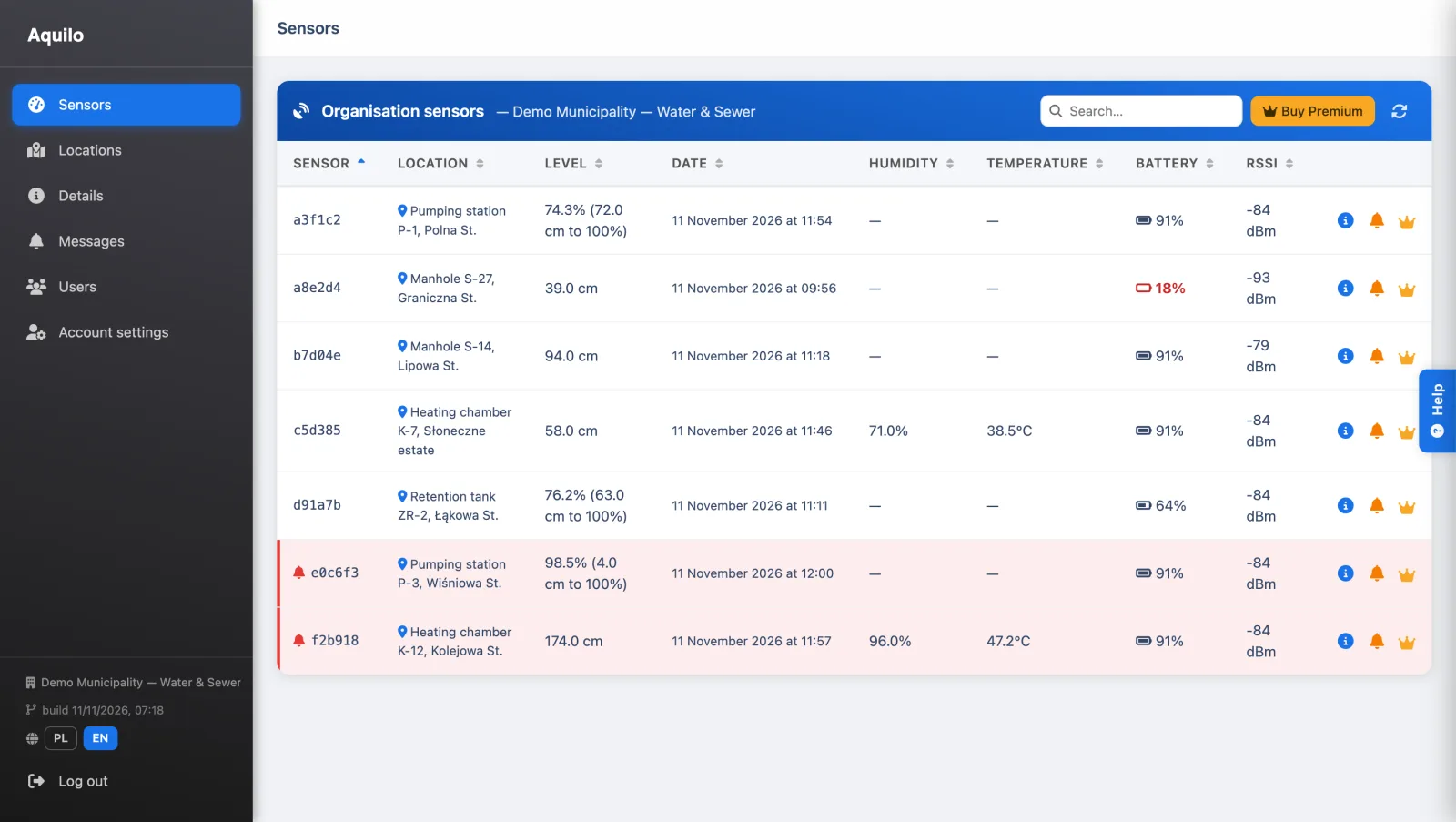
Sensor data is available in the web Panel, a list and a map of all the organisation’s sites with the last reading, battery level and signal, and over the REST API, which can feed SCADA, GIS or a dispatch system. The duty officer sees alarms in the Panel and in the mobile app.
- Web Panel: list and map of all sites, last reading, battery, signal
- Level at every point, flow where the level and flow sensor is installed
- Alarm thresholds on level, flow, flooding, temperature
- Roles and notifications for several people
- REST API with OpenAPI documentation for SCADA/GIS
Premium LTE Flex for each measuring point
€ 4.17/ per month · billed yearly € 50.04 · SIM card included
You buy the sensor once. You pick the plan for how much you want to know: compare plans.
Cheaper together with the sensor: choose the plan on the product page and the discounted price is applied in the cart.
Water & sewer utilities
Rollout for organisations
We start with a few sites, tune thresholds and roles, then scale up. Service and spare parts in the EU.
Rollout enquiry“The device is well thought out and, most importantly, it works. Even in geometrically difficult conditions. The Chinese ultrasonic sensor could not handle the harsh conditions.”
- Organisation account: many sites, administrator / service / viewer roles
- REST API with OpenAPI documentation: data for SCADA, GIS, BI
- Logger mode in LTE for places with patchy coverage
- A pilot on a few sites before the rollout decision
Other applications